Biodiversity
Alongside climate change, the loss of biodiversity is the biggest threat to the planet. In 2022, we surveyed how our operations have affected biodiversity, and how we can play our part in halting the loss of biodiversity. We prepared an action plan for 2023−2027 based on the survey results, focusing on hydropower and thermal power. In terms of nuclear power, the work on biodiversity is carried out by our joint venture Teollisuuden Voima.
Biodiversity is included in our strategy. As a responsible company, we reconcile competitive carbon neutral production with biodiversity. We want to produce hydropower responsibly and use sustainably produced wood-based fuels in CHP.
Our biodiversity vision
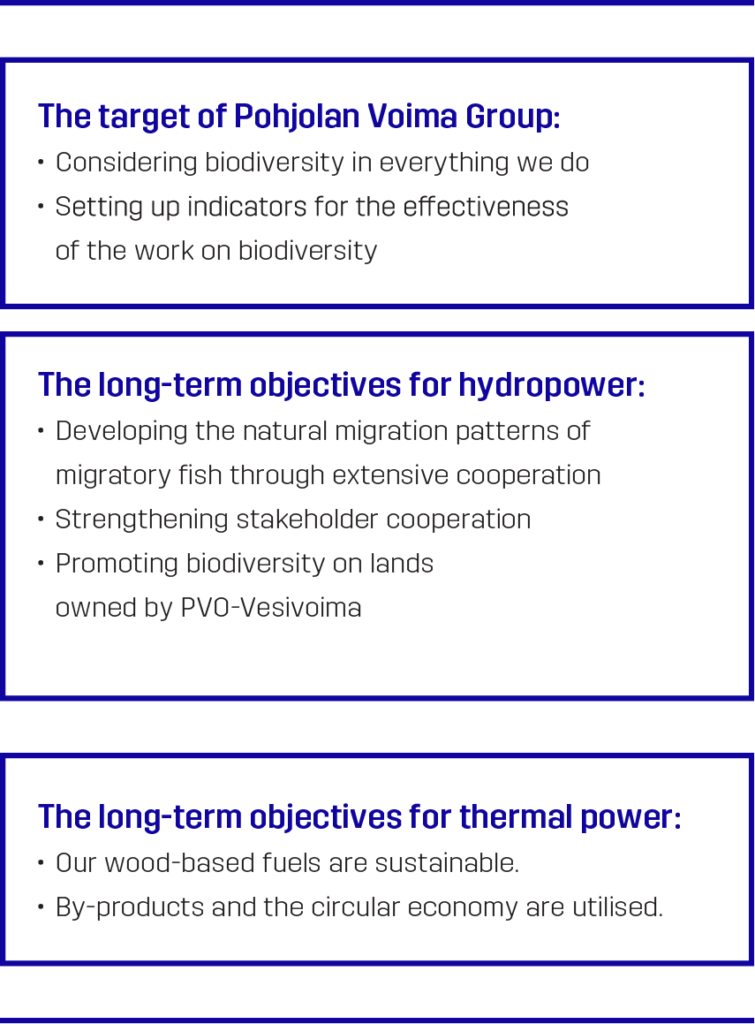
Our long-term biodiversity vision is to identify our key impact on biodiversity and move towards net positivity. We will promote our skill set and update our target as knowledge increases.
We have set long-term goals to achieve our vision:
Biodiversity action plan for 2026
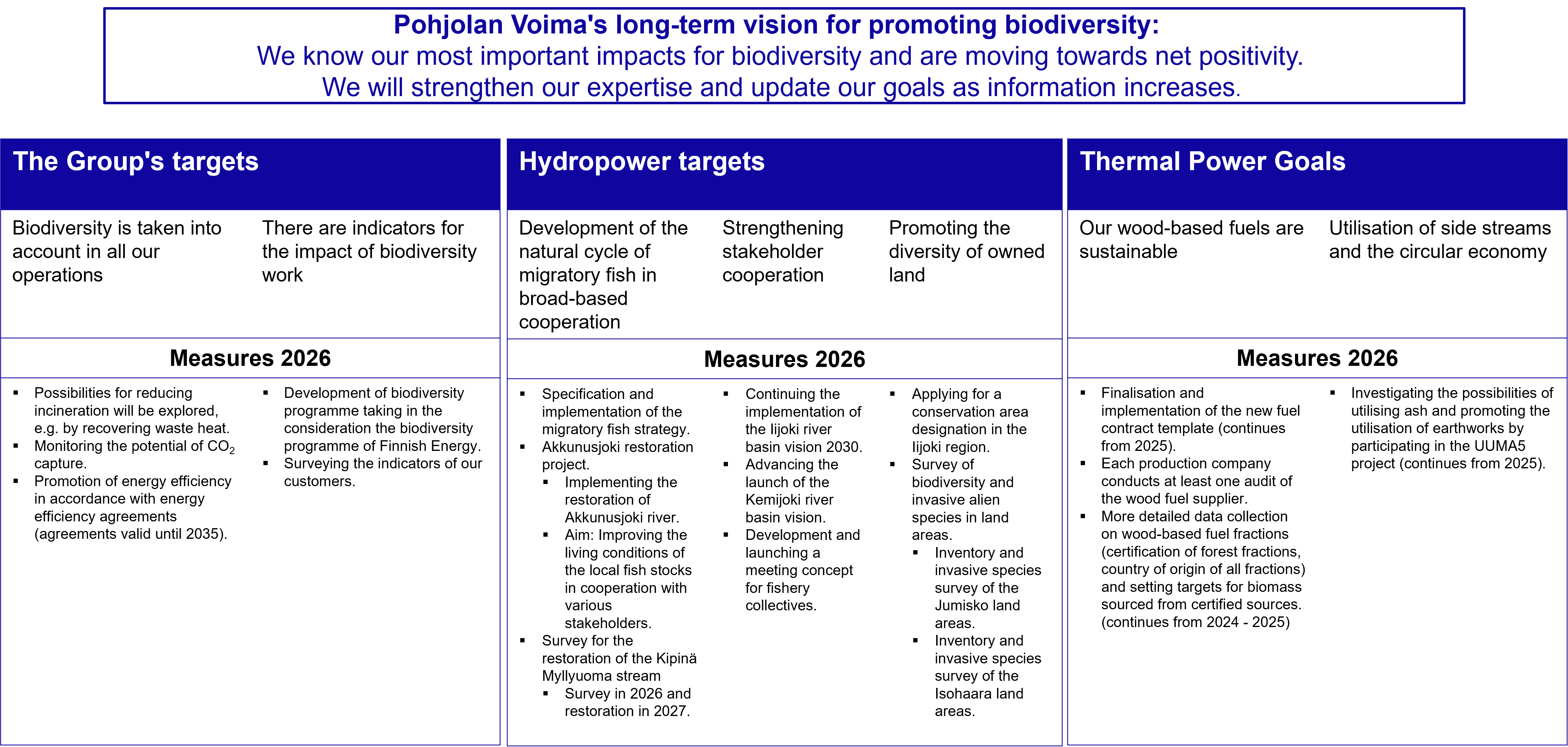
In 2025, we achived 75% of the measures planned for enhancing biodiversity. The implementation of the unfinished measures will continue in 2026. One of the key targets is to develop the metrics for the impacts of the biodiversity efforts.
In hydropower, we continued our collaboration in migratory fish projects
In 2025, we continued cooperation to benefit migratory fish and the aquatic environment in our operating areas.
- Finland’s first downstream migration route for salmon fry, including catching equipment, was introduced at Haapakoski on the Iijoki river in the summer of 2022. The route is developed further and its operation is studied.
- In 2024–2026, the Lohi Iijokeen 2 (Salmon to Iijoki 2) is a a continuation of the extensive cooperation of the previous projects, Lohi Iijokeen 2022–2024 and Iijoen vaelluskalahanke 2020–2022 (Iijoki river migratory fish project). The measures include, among other things, planting fry and producing information on the functionality of the Haapakoski downstream migration route.
- The Iijoki agreement for 2024–2028 is implementing the Iijoki waterway vision 2030 by restoring drained swamps and improving water quality in the Iijoki river catchment area, for example. The agreement is continued from a previous agreement period of 2019–2023.
- The development of the approximately 9 km long old Raasakka riverbed as a natural breeding area for migratory fish continued by the pumping of additional water into the riverbed throughout the summer season.
- The cooperation of a modelling project of the Iijoki old riverbed at Raasakka explored the possibilities of developing the old riverbed into a migratory fish nursery area and migratory fish route.
- A hydraulic fishway, Fishheart, was installed at Raasakka, the lowermost power plant in the Iijoki river in 2023. The functionality of Fishheart was developed and improved in cooperation with the supplier.
- With Fishheart and the downstream migration route at the Haapakoski rapids, an assisted natural cycle of migratory fish has been started and is beeing boosted in the Iijoki river. Fish that pass through Fishheart are moved to nursery areas above Haapakoski. The passage of smolts aiming for the sea arriving at the Haapakoski downstream migration route is monitored, and fish are moved downstream below Raasakka. By researching and developing the impacts, it is possible to obtain valuable research data and more information for next by-pass routes.
- In 2025, the Haukea pataan (Eating pike) cooperation project promoted sustainable fishing and the protection of migratory fish in the Iijoki river.
- PVO-Vesivoima also participates in joint projects to restore migratory fish stocks in the Kemijoki and Ounasjoki rivers. The broader target of PVO-Vesivoima is to create a vision similar to the Iijoki vision for the Kemijoki-Ounasjoki area, created through extensive cooperation.
- PVO-Vesivoima owns the lowermost power plant in the Kemijoki river at Isohaara. The owner of the two current fishways at the Isohaara power plant is the municipality of Keminmaa. PVO-Vesivoima’s target is acquiring ownership or use of the fishways to develop the migratory fish solutions at Isohaara as a whole. The company has sought to promote the natural cycle of migratory fish by surveying different natural and hybrid fishway solutions for the Isohaara power plant.
- PVO-Vesivoima owns 50% of Voimalohi Oy, which manages the breeding, planting and transfer of PVO-Vesivoima’s fish management obligations and implements the migratory fish measures. Voimalohi has been preparing river-specific operational programmes for the Iijoki and Kemijoki rivers in accordance with the shareholders’ migratory fish strategy.
- In 2025, the Käylä fish farm in Kuusamo was acquired. Voimalohi will continue its operations and develop it into a broodstock farm. In addition, the construction of a new plant at the Ossauskoski rapids fish farm in Kemijoki river was started. These measures will support and develop the restoration of fish, fish farming and the planting of fish, as well as the restoration of migratory fish.
Promoting biodiversity on lands owned by PVO-Vesivoima
PVO-Vesivoima has promoted biodiversity on lands it owns in its operation area.
- PVO-Vesivoima funded and implemented as its own project the restoration of a wetland and willow ptarmigan habitat in a former peat bog it owns at Lampisuo in Pudasjärvi. The wetland, willow ptarmigan habitat and forested area form an area of approximately 200 hectares.
- A wetland has been created in an area owned by PVO-Vesivoima in Nokia as part of the LIFE Revives project in cooperation with Pirkanmaa Centre.
- In 2024, PVO-Vesivoima surveyed the nature and alien species of the land areas it owns along the Iijoki river, and in 2025, the company prepared the establishment of a conservation area to retain biodiversity based on the survey results. In addition, a nature survey covering the land areas of the Jumisko hydropower plant was planned in 2025.
We use sustainable wood-based fuels
Pohjolan Voima’s combined heat and power plants use wood-based fuels as their main fuels. The wood-based fuels used meet the sustainability criteria of the Renewable Energy Directive (RED II, sustainability of biomass).
We develop sustainable procurement of wood-based fuels. Our goal is to specify our sustainability criteria related to wood-based fuels and to take the criteria into consideration in our fuel procurement agreements. We will also survey the significance of certification in relation to biodiversity. We will find out the share of our wood-based fuels that come from certified sources and evaluate what kind of targets we can set for certification.
Read more in our Annual Report 2025