Circular economy: by-products to good use, recycled fuel to boiler
For us at Pohjolan Voima, the circular economy means the utilisation of by-products, using recycled fuels and reusing materials.
At three of Pohjolan Voima’s power plants, solid recovered fuel is used as one of the fuels. It replaces some of the other fuels at the power plants. Recycled fuel is used at Porin Prosessivoima, Rauman Biovoima and Alholmens Kraft in Pietarsaari.
Recycled fuel means combustible material that has been processed from separately collected energy waste from trade and industry. In practice, this means paper, cardboard, plastic and wood from demolished buildings, which is then finely chopped by the recycled fuel supplier. Solid recovered fuel does not consist of biowaste.
It makes sense for the circular economy that waste can still be used as an energy source when it cannot be utilised in any other way. In addition, using recycled fuel will further reduce total emissions from power plants.
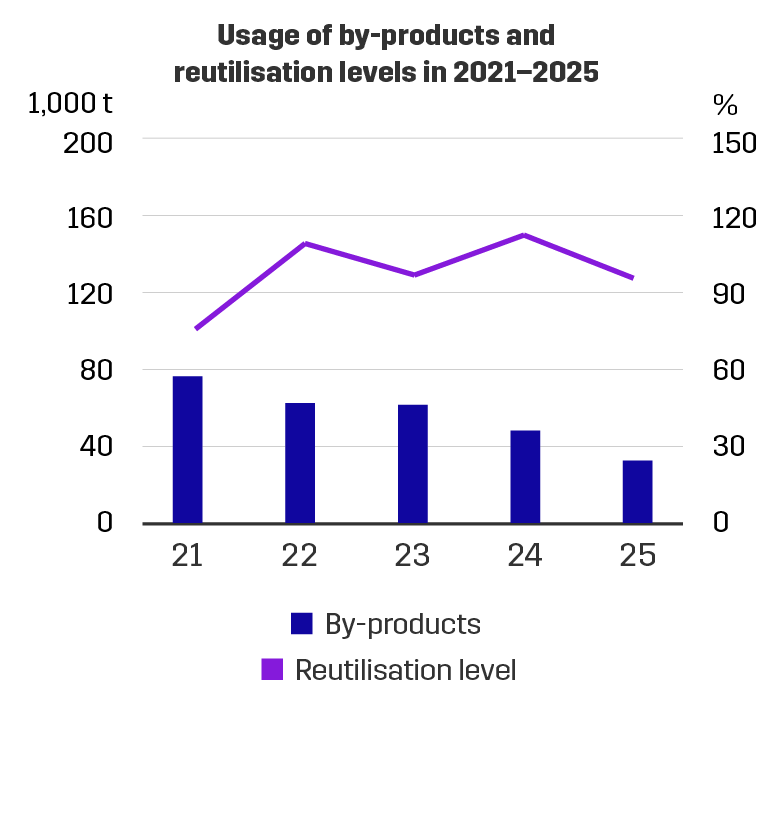
Ash and gypsum harnessed for use
The combustion gas clearing processes at power plants generate ash and gypsum as by-products. They do not go to waste. Instead, they are used in earthwork and as forest fertilisers. The by-products can be used very efficiently.
Ash can be used in earthwork as the filtering layer of roads and parking lots, and in noise barriers, for example. Ash can also be used in industrial processes as raw material for cement, asphalt and concrete, which saves natural resources.
Pohjolan Voima participates in the three-year UUMA5 programme launched in the spring of 2024. UUMA is an extensive cooperation forum that aims to promote earthworks using recovered materials. Pohjolan Voima is involved in a project to develop and promote the reuse of ash.
Fly ash generated by the Kaukaan Voima power plant in Lappeenranta has been granted the status of a by-product used for deep stabilisation and as a forest fertiliser. The status facilitates reuse, allowing more efficient use of the ash to replace cement in the reinforcement of soil during project development, for example. Both emissions and the use of virgin raw materials can be prevented by using the ash, resulting in environmental benefits for climate and biodiversity. Kaukaan Voima is a subsidiary of Pohjolan Voima.
Read further Kaukaan Voima’s fly ash given by-product status – facilitates use in construction and fertilisation
In Pohjolan Voima Group, Rauman Biovoima Oy is the pioneer in using the by-products. It aims for zero-waste energy production.
Rauman Biovoima has participated in a circular economy co-operation projct to turn the old Sampaananlahti bay port basin located in the UPM Rauma mill area into a storage area and to provide access route for the port traffic. The port basin has been filled with a mass that contains ash created at the Rauman Biovoima power plant as a binder, strengthening the soil instead of cement. The reuse of ash has saved non-renewable materials, avoided soil dumping into landfill and reduced the CO2 emissions from construction by more than a half. The project has also provided new information about ash construcion.
Read further Ash from the Rauman Biovoima power plant replaces cement in earthworks in a circular economy project
Rauman Biovoima and Teollisuuden Voima Oy (TVO) are launching a cooperation venture with the waste exempt from control generated at the Olkiluoto power plants treated by Rauman Biovoima in the process of their combined heat and power production plant. This will be the first time that the maintenance waste originating in nuclear power plants is recycled in Finland. Maintenance waste that is exempt from control has been declared safe to people and the environment in terms of its radiation properties.The waste to be sent for incineration consists of, for example, overalls, gloves, and plastic covers. Any materials that are poorly suited to incineration are removed from the waste before it is sent.
Efficient recycling of demolition waste
The structures and equipment at oil and coal power plants that are to be demolished are recycled.
Production operations at Tahkoluoto power plant in Pori and at Kristiina power plant in Kristiinankaupunki ended in 2015, and the plants were demolished in 2020 and 2021. Previously, in 2015, the Mussalo power plant in Kotka was demolished. In addition, The Laanilan Voima power plant in Oulu was demolished in 2022–2023, and the final part in 2025.
The principles of the circular economy guided the demolition work. All reusable material has previously been directed for reuse, either as it is or as recycled materials. Almost all the materials have been reused in one way or another.